Functional Systems and Catalysis
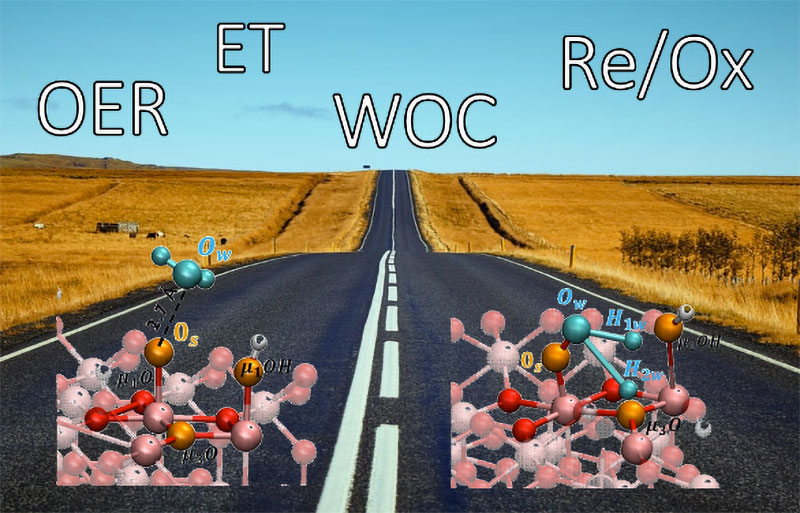
We advance computational methods to gain a deep understanding, predict, and design processes like catalysis, driving sustainable energy solutions and eco-friendly technologies.
Advancing computational approaches for study and design of functional systems
We aim to improve simulations to more accurately describe chemical processes, with a particular focus on dynamic approaches like DFT-based molecular dynamics. These methods incorporate environmental and finite temperature effects under ambient conditions, using techniques such as explicit solvents and periodic boundary conditions for the condensed phase. We also integrate enhanced sampling methods and machine learning to go beyond traditional static approaches for studying and analysing reaction mechanisms and networks.
Other directions include the in silico design of novel catalysts and the calculation of properties like pKa values and redox potentials using DFT-based molecular dynamics. We also advance the accurate modelling of (photo-)electrochemical systems, e.g. with grandcanonical approaches, and develop advanced solvent continuum models.
We are interested in highly accurate electronic structure methodologies to tackle demanding systems with multireference character such as transition metal compounds. For highly accurate simulations beyond DFT, we use wavefunction-based methods. We have, for instance, developed approaches to calculate complete reaction pathways using complete active space methodologies and studied magnetic properties of involved transition metal systems using a variety of methods ranging from Quantum Monte Carlo up to Density Matrix Renormalization Group approaches. Moreover, we have implemented wavefunction-in-DFT embedding for both molecular and extended systems leveraging the capabilities of CP2K and OpenMolcas.
Catalysts for sustainable chemistry
Recent efforts have, for instance, focused on developing efficient water splitting catalysts for sustainable hydrogen generation, in collaboration with experimental groups. To design and predict better catalysts, it is crucial to understand the entire water splitting process, including catalyst structure, behaviour, and reaction mechanisms/networks. Our research aims to provide a detailed understanding of both homogeneous and heterogeneous (photo-/electro-)catalysts with explicit solvent, using advanced (DFT-based) molecular dynamics methodologies and enhanced sampling techniques for a realistic view of processes under ambient conditions, also leveraged by machine learning/multi-scaling techniques.
Selected Publications
Ziwei Chai, S. Luber
Anisotropic Interface Continuum Solvation Model and the Finite-Element Anisotropic Poisson Solver
J. Chem. Theory Comput., 2025, 21, 11747-11760
Z. Chai, S. Luber
Functional analytic derivation and CP2K implementation of the SCCS model based on the solvent-aware interface
Comp. Phys. Comm., 2025, 311, 109563
D. Tang, R. Ketkaew, S. Luber
Machine Learning Interatomic Potentials for Heterogeneous Catalysis
Chem. Eur. J., 2024, e202401148
Z. Chai, S. Luber
Grand Canonical Ensemble Approaches in CP2K for Modeling Electrochemistry at Constant Electrode Potentials
J. Chem. Theory Comput., 2024, 20, 18, 8214-8228
R. Verduci, F. Creazzo, F. Tavella, S. Abate, C. Ampelli, S. Luber, S. Perathoner, G. Cassone, G. Centi, G. D’Angelo
Water Structure in the First Layers on TiO2: A Key Factor for Boosting Solar-Driven Water-Splitting Performances
J. Am. Chem. Soc. 2024, 146, 26, 18061-18073
L. Schreder, S. Luber
Implementation of frozen density embedding in CP2K and OpenMolcas: CASSCF wavefunctions embedded in a Gaussian and plane wave DFT environment
J. Chem. Phys., 2024, 161, 144110
F. Creazzo, S. Luber
Modeling of solid-liquid interfaces for water splitting catalysis
Book Chapter, Molecular Sciences and Chemical Engineering, Elsevier, 2023
R. Han, S. Luber, G. L. Manni
Magnetic Interactions in a [Co(II)3Er(III)(OR)4] Model Cubane through Forefront Multiconfigurational Methods
J. Chem. Theory Comput. 2023, 19, 10, 2811–2826
N. Plainpan, R. Ketkaew, S. Luber, K. Sivula
Enabling Direct Photoelectrochemical H₂ Production using Alternative Oxidation Reactions on WO₃
Chimia 2023, 77, 110
L. Schneider, M. Kalt, S. Koch, S. Sithamparanathan, V. Villiger, J. Mattiat, F. Kradolfer, E. Slyshkina, S. Luber, M. Bonmarin, C. Maake, B. Spingler
BODIPY-Based Photothermal Agents with Excellent Phototoxic Indices for Cancer Treatment
J. Am. Chem. Soc. 2023, 145, 8, 4534–4544
R. Ketkaew, F. Creazzo, S. Luber
Closer Look at Inverse Electron Demand Diels–Alder and Nucleophilic Addition Reactions on s-Tetrazines Using Enhanced Sampling Methods
Top Catal, 2022, 65, 366–382
F. Creazzo, S. Luber
Explicit solvent effects on (1 1 0) ruthenium oxide surface wettability: Structural, electronic and mechanical properties of rutile RuO2 by means of spin-polarized DFT-MD
Applied Surface Science, 2021, 570
F. Creazzo, S. Luber
Water-Assisted Chemical Route Towards the Oxygen Evolution Reaction at the Hydrated (110) Ruthenium Oxide Surface: heterogeneous catalysis via DFT-MD & metadynamics simulations
Chem. Eur. J., 2021, 27,17024-17037
M. Schilling, R. Ketkaew and S. Luber
How ab initio Molecular Dynamics Can Change the Understanding on Transition Metal Catalysed Water Oxidation
Chimia, 2021, 75, 03, 195-201
M. Schilling, R.A. Cunha, S. Luber
Enhanced Ab Initio Molecular Dynamics Exploration Unveils the Complex Role of Different Intramolecular Bases on the Water Nucleophilic Attack Mechanism
ACS Catal., 2020, 10, 14, 7657-7667
R. Han, S. Luber
Complete active space analysis of a reaction pathway: Investigation of the oxygen–oxygen bond formation
J. Comput. Chem., 2020, 41, 1586-1597
M. Schilling, R.A. Cunha, S. Luber
Zooming in on the O–O Bond Formation—An Ab Initio Molecular Dynamics Study Applying Enhanced Sampling Techniques
J. Chem. Theory Comput., 2020, 16, 4
M. Schilling, S. Luber
Determination of pKa values via ab initio molecular dynamics and its application to transition metal-based water oxidation catalysts
Inorganics, 2019, 7 (6), 73
S. Luber
Advancing Computational Approaches for Study and Design in Catalysis
Chimia, 2018, 72 (7-8), 508-513
M. Schilling, M. Böhler, S. Luber
Towards the rational design of the Py5-ligand framework for ruthenium-based water oxidation catalysts
Dalton Trans., 2018, 47, 10480-10490
F. H. Hodel, S. Luber
Redox-Inert Cations Enhancing Water Oxidation Activity: The Crucial Role of Flexibility
ACS Catal., 2016, 6, 6750–6761.
M. Schilling, G. R. Patzke, J. Hutter, S. Luber
Computational investigation and design of cobalt aqua complexes for homogeneous water oxidation
J. Phys. Chem. C, 2016, 120, 7966–7975.
F. H. Hodel, S. Luber
What influences the water oxidation activity of a bioinspired molecular CoII4O4 cubane? An in-depth exploration of catalytic pathways
ACS Catal., 2016, 6, 1505–1517.
F. Evangelisti, R. Moré, F. Hodel, S. Luber, G. R. Patzke
3d-4f {CoII3 Ln(OR)4} cubanes as bio-inspired water oxidation catalysts
J. Am. Chem. Soc., 2015, 137, 11076–11084 (highlighted in Chimia Issue 11-2015)